We received a spider plant from Ian’s pa recently. He keeps several spider plants outside by the driveway. Whenever we visit, we see them all in a row sitting in pots. So this plant is from that collection.
The plant he gave us is variegated, with a single white stripe running through each green leaf.
Spider plants, also known as Chlorophytum comosum or airplane plants, are notorious for being durable and tolerant to most abuses. They are popular for hanging in baskets and good for filtering air. They also propagate easily. In fact, the plant we received had a lot of plant babies attached!

Notice how the plant babies are attached to these long stalks. One plantlet per stalk. Theoretically, you can leave them hanging there for a long time when inside the house. I saw a video of someone who kept them on for over a year. I guess the plantlets stay small if you leave them on like that. Out in nature, the plantlets eventually touch the ground and form roots that way.

Here is a close up. Notice the itty-bitty roots starting to grow. I decided the plantlets were big enough to remove, so I clipped off each plantlet by cutting the stalk portion as close to the plantlet as possible. Definitely avoid cutting the node, which is at the base of the plantlet, because that’s where the roots grow.

Here they are… all 23 new plants! They look happy and healthy. Some are definitely smaller than others. The smaller ones must be younger I suppose.

Here is close up of a plantlet. Very cute. It’s a perfect miniature of the big plant.
I’m not sure what to do with all of these baby plants, but I planned to propagate them in water anyway. Usually, I put cuttings in jars of water and leave them by the window. This can be somewhat of a nuisance though, because when there are a lot of cuttings in a jar, it becomes a hassle to remove them every time to replace the water.

So I had a new idea. This plastic bowl and strainer is something I saved from a frozen microwave meal. It was the type of meal that involved steaming vegetables. It looked like a useful strainer, so I washed it and saved it. Now it can be put into plant action.


My idea was to lace a string through the top holes in a zig-zag pattern, as seen above. The string becomes a rack for the plant cuttings to sit on. Then the strainer sits in the bigger bowl, which is filled with water. Now it is easy to lift the cuttings and replace the water when needed.

All of the plantlets fit in perfectly. There was leftover room for a few of my Peperomia obtusifolia leaf cuttings, too. I am very pleased with the results. If you ever find a plastic strainer in your frozen microwave dinner, I recommend that you save it for your future 23 spider plant cuttings.

After removing the plantlets, I trimmed off the stalks by cutting them at the base of the main plant. The main spider plant became easier to handle without these stalks in the way.


There was some damage on the plant, mainly from sitting outside for a while. I trimmed off the dead and damaged leaves to give the plant a fresh start. I debated between keeping the plant outside, since it’s accustomed to that environment, or keeping it inside. In the end, I decided to turn this into an inside houseplant.

The plant looks dapper after its haircut! Nice and green.
Next, I wanted to repot the plant and give it new soil. It’s good to do that every now and then. It took some effort to work the plant out of its pot. I’m guessing it’s been in the same pot for a few years. I worked a stick around the inner edge of the pot, the same way you get brownies out of a baking pan, and dumped the plant out.

I was surprised! Look at these roots. The plant was very rootbound. This happens when the plant’s roots reach the bottom of the pot and begin to wind back up and around the walls because there is no more space. In particular, I think spider plants are prone to this trouble. They grow quick and are hardy, as I mentioned before.
This was my first time encountering something like this, so I wasn’t sure what to do.

After doing some research on YouTube, this turned out to be a very common problem. In fact, a few of the videos were about spider plants. The experts said you want to avoid this rootbound situation, because the roots leave no room for soil. Therefore, not much nutrition will reach the plant. Also, plants like to have some air circulating around the roots.
The solution is to lop off the roots. It seems extreme, but all the gardeners I watched took clippers to the roots, and began cutting and trimming without restraint. “It will hurt your plant if you DON’T do this,” as one of them explained.

If you look closely, you will notice big tap roots, which are different from the smaller fibrous roots. The goal is to avoid cutting the big tap roots. It is perfectly fine to cut through the smaller fibrous roots though.
When the plant is rootbound, you may need to make a few vertical slices along the outer wall. After making these slices, it becomes easier to untangle and comb the roots straight with your fingers. The image above shows my plan of attack. I cut a few times vertically around the root ball.

Here are the roots untangled. It took me maybe twenty minutes to work them straight. The roots were long… easily over three feet at least. A super mighty plant.
By the way, the big tap roots reminded me of tubers. From what I read, the tap roots store a lot of water, so the plant can survive dry, drought-like conditions. Spider plants originate from Africa, so this makes sense.


I wasn’t sure how much roots to trim off, but I wanted to the plant to fit within an 6-inch pot for indoor living, which is similar to the size of its original pot. In the end, I trimmed off the really long roots and a few of the tap roots. I think the root ball should be proportional to the size of the upper plant.
Surely, the plant will survive… right?
If not, I do have 23 back ups.

I rinsed the plant off with a hose afterwards to wash away dirt from the leaves (using the mist setting of the hose attachment). It looks very happy after its repotting and shower!
I think cutting the roots, leaves, and repotting like I did today can be traumatic for a plant. Hopefully, the drastic change isn’t too much of a shock.

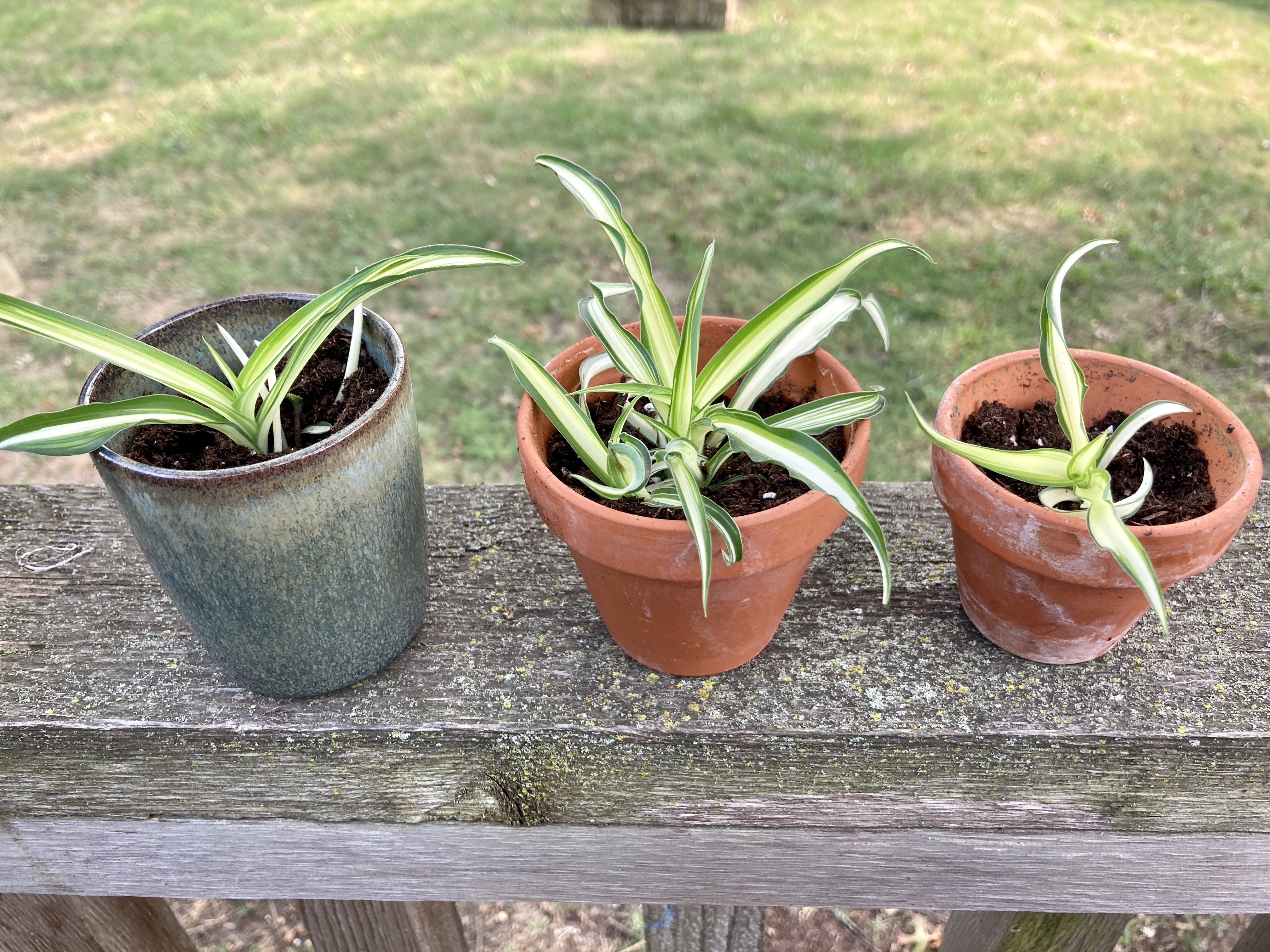
I stuck a few baby plants in little pots. They are extremely cute. 🙂
Ian is keeping a couple of these in his office. I’m not sure how fast spider plants grow, but maybe these tiny ones will stay small for a while. Next, I want to create a plant hanger for the main spider plant, but that’s a post for another time.
Leave a Reply