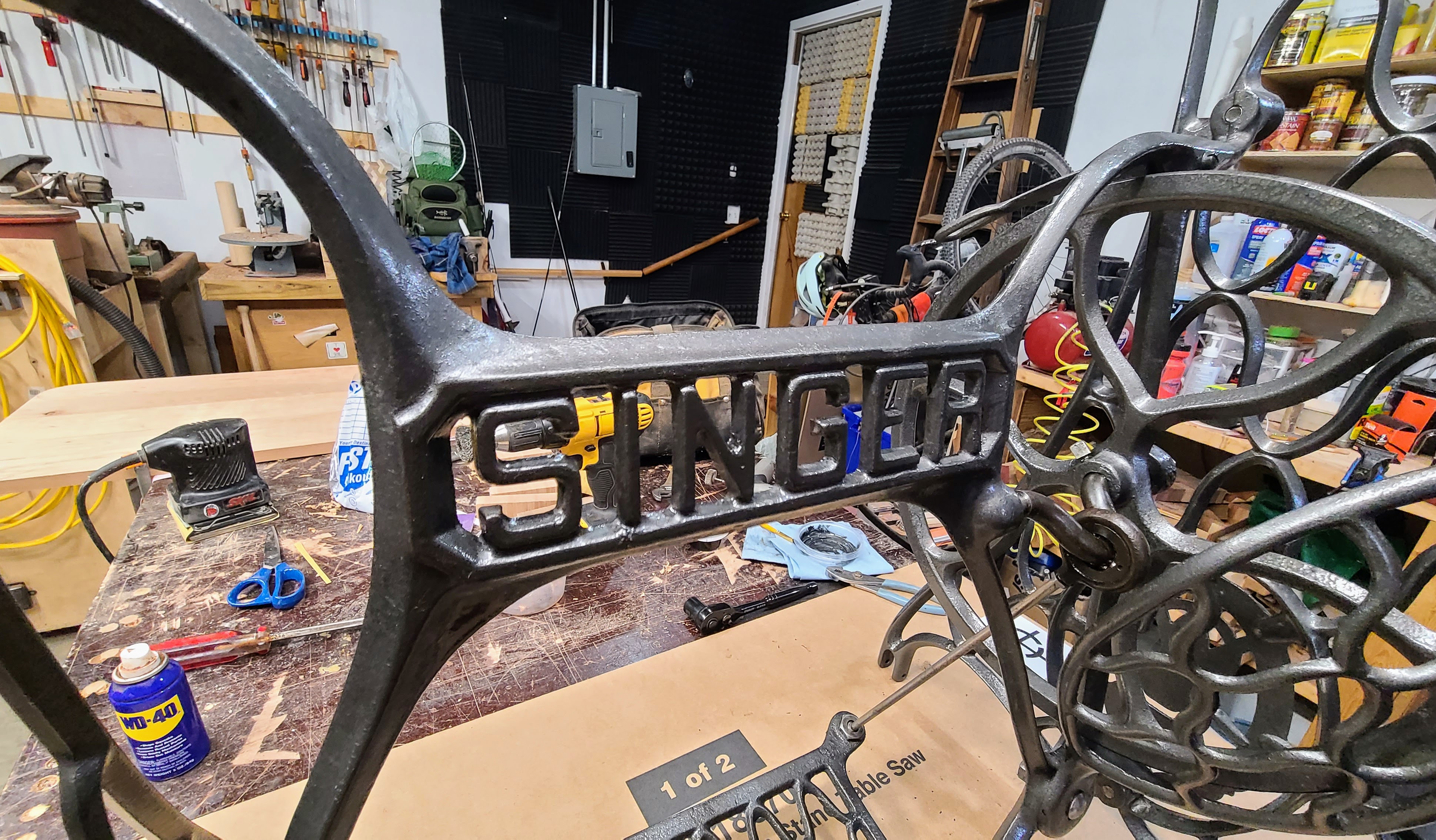
A friend of my Mother-In-Law has a vintage Singer sewing machine table that she was interested in restoring. I think it is a “Model 27” that dates back to 1911. You can find more fascinating info on Wikipedia. My guess is you or your relatives have one of these somewhere, probably in a back room or basement. Just go look, you may be surprised.
The veneer on the wood top had been painted a couple of times and was peeling up. The oak core looked to have some moisture issues. So, basically none of it was salvageable. I kept the drawers which were pretty beat up, but might come in handy some day.
The cast iron base had some rusty areas.


I disassembled the base and put all of the screws and bolts in a WD-40 bath. After many hours of scrubbing the base with a wire brush, I cleaned the pieces with vinegar and baking powder.
I made this (pretty cool) spray area out of some thick cardboard and coated the iron with black, “Hammered”, Rust-Oleum paint. The way it coats the surface gave the metal a cast-iron like feel.


After a couple of coats, I reassembled the base. It looked pretty good.


For the top, we decided on Cherry, which is always a good choice. I ripped the wood square and dowel joined the boards.

After much sanding and jigging of saws, it was smooth and the corners were rounded.


Here is a dry fit on the base.

The owner of the table wanted a routed edge and we settled on a Roman Ogee profile (which is a thing). I did get a little burn out from the router and I spent some time sanding the edge to get most of it out.


But, oh no, there was a crack at the end of one of the boards. I wanted the patch to be less noticeable, so I stopped it with a cherry dowel, cut it with a flush saw, and sanded. You’ll also notice a knot that I filled with wood putty.


3 coats of Shellac and 3 coats of Polyurethane per usual to bring out the natural wood colors and to protect it from UV light.


I attached the top with the original screws, which I polished.

Here are couple shots of it looking shiny.


I wanted to point out the original polished hardware. It was important to me to keep the soul of the base, so to speak. I lathed a couple cherry wheels and picked up some bolts and lock nuts to mount them. The foot pedal, thanks to WD-40, is still operational too.


Here is the backside. Kristy and I delivered the table and the owner she was pleased. She even made us home made egg rolls. I can’t stop talking about those home made egg rolls!

Working on the table was another fun restoration-type project. I learned a lot more about early 20th century sewing machine table mechanics than I though I ever would. Hopefully the table will be around for another 100 years!

Leave a Reply